
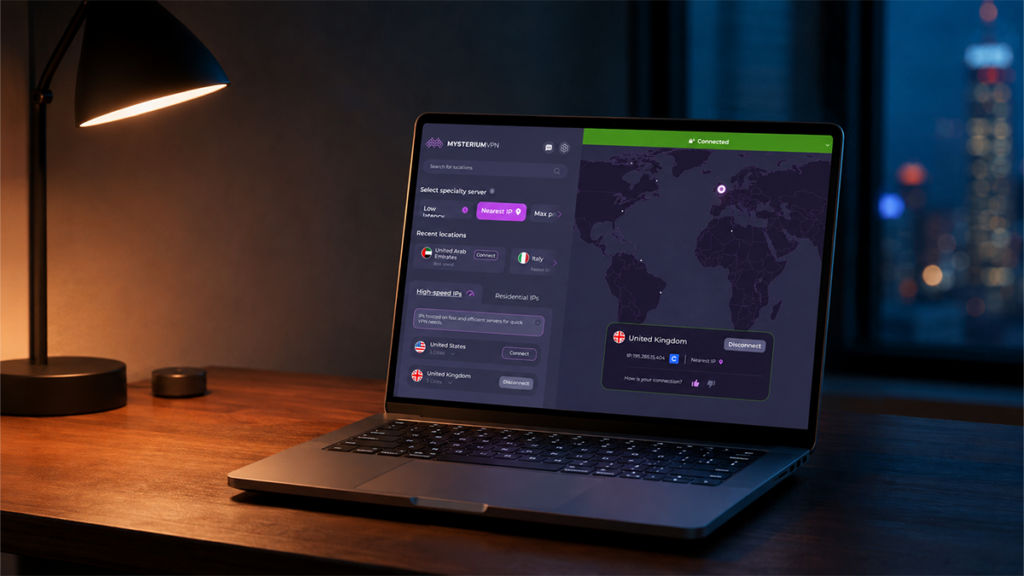
I’ve always found VPNs a little funny. They’re supposed to make the internet feel simpler and more private, yet some services seem determined to bury users under endless features, complicated menus and promises that sound like they were written by a marketing robot.
So when looking at a residential VPN, I think it makes sense to step back and ask a more basic question: what does it actually change about the way someone uses the internet?
That’s where this particular approach gets interesting. Instead of relying entirely on a traditional centralized VPN network, the service uses a decentralized network with residential IP addresses operated by independent people around the world. And honestly, that’s a pretty different idea from the usual VPN setup.
Why the IP address matters more than it sounds
Most people probably don't think about their IP address while browsing. I certainly don't sit there checking mine while drinking coffee in the morning.
But the IP address is one of the first things websites can see about a connection. It can reveal an approximate location and, depending on the type of address, make it fairly obvious that the traffic is coming through a VPN or hosting provider.
Residential IPs work differently because they come from regular residential connections rather than being tied purely to conventional data centers. That can make a connection look more like ordinary internet traffic.
For anyone specifically searching for a residential ip vpn, this is probably the biggest reason to pay attention to this type of service.
It can be useful when websites are suspicious of traditional VPN addresses, when certain content is restricted by location or when someone simply wants a different kind of connection than the standard server-in-a-data-center model.
And yes, it’s not some magical invisibility cloak. Websites can still use plenty of other signals. Anyone promising that a VPN makes you completely invisible online deserves at least one raised eyebrow.
The decentralized idea caught my attention
The biggest difference here isn't actually another checkbox in a feature list. It’s the network itself.
Instead of every exit point being controlled by one central company, the network is built around independent node operators around the world. The idea is to make the infrastructure more decentralized rather than putting everything under one corporate roof.
That fits into a much bigger conversation happening online in 2026. Internet censorship, platform restrictions, regional fragmentation and concerns about surveillance haven't exactly disappeared. If anything, the question of who controls access to information feels more relevant than it did a few years ago.
The philosophy behind the service is therefore pretty straightforward: fewer gatekeepers, more choice and an internet that isn't unnecessarily restricted by borders.
Whether someone cares deeply about decentralization or just wants to watch content available in another country, the underlying concept is interesting either way.
What I’d actually use it for
For me, the practical side matters more than the philosophy.
I’d want a VPN to work when I need it without turning every connection into a small IT project. That's especially true on a phone. Nobody wants to be standing outside a café, staring at a loading screen while trying to figure out why their VPN has decided today is the perfect day to become philosophical.
Location choice is one area where the setup makes sense. The network covers more than 100 countries and offers thousands of residential IPs, with location selection available depending on the connection.
That opens up a few obvious use cases. Travelling is one. Someone might want their internet traffic to appear as though it's coming from home rather than whatever hotel, airport or café network they're currently using.
Streaming is another obvious example. Residential addresses can sometimes have an advantage over heavily used data-center addresses, although there’s no guarantee that every streaming platform will work with every location. Services constantly change their detection methods, so anyone claiming universal access to everything forever is probably selling more confidence than reality.
The everyday features are there too
The interesting thing is that the decentralized network doesn't mean the basic VPN features have been forgotten.
There’s support for WireGuard, modern ChaCha20 encryption, DNS and IP leak protection, a kill switch and a no-logs approach. In normal language, those are the bits that help keep the connection private and prevent your real connection from accidentally being exposed if something goes wrong.
The kill switch is one feature I particularly like seeing in any VPN. If the VPN connection suddenly drops, it can stop internet traffic instead of quietly switching back to the normal connection.
There’s also support for up to 15 devices simultaneously. That's more than enough for most households unless someone has somehow connected the toaster to Wi-Fi too.
The service supports Windows, macOS, Android and iOS, while browser extensions are available for Chrome, Brave, Opera and Opera GX. Router and Linux support are also in development, which could make the service more interesting for people who want VPN protection beyond individual devices.
Is it actually a good residential VPN?
This is where I’d separate the service from the usual “fastest VPN in the universe” marketing.
The strongest argument isn't simply speed or the number of buttons inside the app. It's the combination of residential IPs and decentralized infrastructure.
For someone who specifically needs a residential VPN, that distinction matters. The network offers more than 7,500 residential IPs across 100+ countries, giving users a much broader pool than a basic VPN with a handful of conventional server locations.
At the same time, there are still the things I’d check before committing. How well does a particular location work for the website I need? Are speeds good at the time I’m using it? Does a particular streaming platform accept the IP? These things can change because websites change their own systems.
That’s why I wouldn't judge any VPN purely from a feature list.
Privacy without the usual corporate feeling
Another part I find interesting is the project's stance on privacy and decentralization.
The service is positioned as an alternative to the increasingly centralized internet, rather than simply another company selling a VPN subscription. It also says it doesn't keep logs and follows GDPR requirements.
There’s an additional trust angle here too. The service is part of the i2Coalition's VPN Trust Initiative and has the VPN Trust Seal, which is intended to demonstrate adherence to industry principles around security, privacy and transparency.
That doesn't mean users should stop thinking critically. No VPN should get a free pass simply because it has a shiny badge. Still, independent industry oversight is preferable to simply taking a company's privacy claims at face value.
My overall take
After looking at the service from a practical user's perspective, I think its biggest strength is that it doesn't feel like it's trying to be another copy of the same VPN product.
The residential IP network is the main attraction. More than 100 countries, thousands of residential addresses and a decentralized infrastructure create a setup that's particularly interesting for people dealing with location restrictions, websites that dislike conventional VPN addresses or anyone who wants more control over where their connection appears to come from.
For someone searching for the best residential VPN, I’d put this type of service firmly on the shortlist rather than treating it like just another generic VPN.
It isn't going to solve every internet restriction, and no honest review should claim that it will. But the combination of residential IPs, privacy features, location choice and decentralization makes it a genuinely different proposition.
And perhaps that's what I like most about it. In a VPN market where everyone seems to be shouting about having the biggest, fastest and most secure network, taking a completely different route is actually refreshing.
If residential IPs or a decentralized internet matter to you, it’s worth looking beyond the usual VPN comparison charts and seeing whether this approach fits the way you actually use the internet.