

Competitor analysis sounds simple enough.
Find your competitors. Look at their followers, engagement, posting frequency, and best-performing content. Put the numbers into a spreadsheet. Compare everything.
The problem is that social media data can look much more useful than it actually is.
A competitor may have 500,000 followers, but that doesn’t necessarily mean its audience is valuable. A post may receive thousands of likes while generating almost no meaningful business results. A sudden spike in engagement might look impressive until you discover it came from a one-off viral post that has nothing to do with the company’s usual performance.
The real challenge isn’t collecting more competitor data.
It’s figuring out which data deserves your attention.
Start With the Metrics That Explain Performance
The easiest mistake in competitor analysis is tracking whatever is easiest to count.
Followers are a good example.
They’re useful for understanding the general size of a competitor’s social presence, but follower count alone tells you very little about how effectively that audience is being reached.
Instead, look at metrics that provide context:
Engagement relative to audience size
Average engagement per post
Posting frequency
Content formats that consistently perform well
Topics that generate discussion
Video views and completion signals when available
Growth trends over time
Calls to action and the responses they generate
The word consistently matters here.
One successful post can be interesting. A pattern of successful posts is much more useful.
If a competitor repeatedly gets strong engagement from short educational videos, for example, that’s a potentially useful insight. If one unrelated meme receives ten times the usual engagement, copying it probably isn’t a strategy.
Don’t Treat Every Competitor as a Direct Competitor
Another common problem is comparing yourself with businesses that aren’t really competing for the same audience.
A company can operate in the same industry without targeting the same customers.
Consider a skincare brand. Its competitor analysis might include:
Premium skincare companies
Affordable mass-market brands
Direct-to-consumer startups
Retailers selling similar products
Influencers that compete for the same audience’s attention
These groups can provide different types of information.
A premium competitor might teach you about positioning. A smaller startup might reveal emerging content trends. An influencer might show which topics are gaining attention before brands begin using them.
So competitor analysis shouldn’t necessarily mean asking, “Who sells the same thing?”
A better question is:
“Who is competing for the attention and purchasing decisions of the same people?”
Track Content Patterns, Not Just Top Posts
Looking at a competitor’s top ten posts is tempting.
It’s also potentially misleading.
Top-performing posts are, by definition, unusual. If you only study them, you can end up building your strategy around exceptions.
Instead, look for patterns across a larger sample.
For example, you might discover that a competitor posts five times a week, but most of its engagement comes from two recurring formats. Perhaps product demonstrations consistently outperform polished brand photography. Or customer stories generate more comments than promotional announcements.
Those observations are much more actionable than simply knowing which post received the most likes.
A useful competitor analysis should eventually answer questions such as:
What topics does this brand talk about repeatedly?
Which formats seem to perform consistently?
How often does it publish?
How does it introduce products or offers?
Does its audience respond more to educational, entertaining, or promotional content?
Are there noticeable changes in its strategy over time?
That’s where the analysis starts becoming useful.
Be Careful With Engagement Numbers
Engagement looks objective.
It isn’t always.
A post with 2,000 likes may seem dramatically more successful than one with 300. But context matters.
The first post might have reached a huge audience through paid promotion. The second might have reached a smaller but highly relevant audience organically.
You also can’t always see the full picture from public metrics.
Depending on the platform, some important signals may not be publicly available. Saves, shares, clicks, conversions, audience demographics, and paid distribution can be difficult or impossible to evaluate from the outside.
That means competitor analysis should be treated as directional intelligence, not a perfect reconstruction of another company’s performance.
You’re looking for clues, not their entire analytics dashboard.
Location Can Change What You See
This becomes particularly important when analyzing international competitors.
Social platforms and search engines don’t necessarily show identical experiences to every user. Location can influence search results, advertising, product availability, recommendations, and even which content becomes visible.
Imagine you’re analyzing how a competitor appears in France, Germany, and the United States.
If your research consistently reflects only one market, you may draw conclusions that don’t apply elsewhere.
The same issue can appear when monitoring competitors’ websites alongside their social activity. Prices, promotions, product availability, and search visibility can differ between locations.
For larger research projects, businesses may use a scraping API
to automate the collection of publicly available web information from different locations rather than relying entirely on manual checks.
For example, a localized collection strategy could help answer questions such as:
Does a competitor show different prices in different countries?
Are certain products available only in specific markets?
Do search rankings change by location?
Are competitors running different promotions across regions?
The important point is that where the data comes from can affect what the data says.
Freshness Matters More Than You Think
Social media moves quickly.
A competitor can launch a campaign in the morning, change its messaging in the afternoon, and remove a post by the evening.
Website data can become outdated just as quickly.
A product that was available yesterday may be sold out today. A promotion can expire. A property listing can disappear. A search ranking can change.
This matters if your competitor analysis combines social media observations with broader market research.
An old data point isn’t necessarily a bad data point. It simply needs to be treated as historical information rather than a description of the current market.
For fast-changing categories, recording when information was collected can be almost as important as recording the information itself.
Ignore Vanity Metrics That Don’t Answer a Question
Before adding another column to your competitor-analysis spreadsheet, ask what decision that column will help you make.
If the answer is “none,” you probably don’t need it.
This is especially useful for metrics such as:
Raw follower counts without growth context
Total lifetime post likes
Number of posts without engagement context
One-off viral posts
Generic industry averages that don’t match your market
Data collected at inconsistent intervals
None of these numbers are automatically useless.
They’re simply easy to overvalue.
A good metric should help explain something.
If you’re trying to understand content strategy, posting frequency may matter. If you’re evaluating audience response, engagement rate may matter. If you’re studying international positioning, location-specific pricing or search visibility may matter.
But collecting 50 metrics just because they’re available doesn’t make an analysis 50 times better.
Usually, it just makes the spreadsheet harder to understand.
Watch for Data Quality Problems
There’s another issue that’s easy to miss: the data itself may be wrong.
Not obviously wrong.
Almost right.
A competitor’s product price could be collected from the wrong country. A search result could reflect the wrong location. A page could load incompletely and leave important information out. A listing might have disappeared several days earlier while remaining in an outdated dataset.
The resulting spreadsheet can still look perfectly professional.
That’s what makes bad data dangerous.
When competitor research becomes automated or involves large volumes of web information, technical factors such as IP reputation, location targeting, JavaScript rendering, retries, and request reliability can affect what gets collected.
GoProxies is one example of a scraping API tool that combines location targeting with features such as proxy rotation, JavaScript rendering, CAPTCHA handling, and retries.
The technology isn’t a substitute for good research methodology. It simply addresses some of the practical problems that appear when collecting web data at scale.
Don’t Confuse Competitor Activity With Competitor Success
This may be the most important distinction in the entire analysis.
You can see what a competitor does.
You usually can’t see exactly what that activity produces.
A brand might publish ten times a week. That doesn’t mean it is more successful than a competitor publishing twice a week.
A company might have millions of followers but weak commercial results. Another might have a much smaller audience that converts extremely well.
Your goal isn’t to recreate someone else’s social media calendar.
It’s to understand what appears to be working, identify gaps, and form better hypotheses about your own strategy.
That means competitor analysis should lead to questions rather than conclusions.
Instead of:
“They post Reels, so we should post Reels.”
Try:
“Their short-form educational content consistently generates more engagement than their product announcements. Could educational content be addressing a stronger audience need?”
That’s a much better starting point.
Compare Trends Over Time
A single snapshot tells you what a competitor is doing today.
A series of snapshots can tell you where they’re going.
This is why historical tracking is valuable.
You might notice that a competitor:
Gradually increases video content
Starts talking about a new product category
Reduces promotional posts
Changes its tone
Begins targeting a different audience
Expands into new geographic markets
Responds to a trend before other competitors do
These changes can reveal strategic shifts that aren’t obvious from looking at one week’s worth of posts.
The exact timeframe depends on the industry. A fast-moving consumer brand may benefit from weekly monitoring, while a slower B2B market might be easier to understand through monthly comparisons.
Consistency is more important than collecting data constantly.
Build a Smaller, Better Dashboard
A useful competitor dashboard doesn’t need hundreds of metrics.
A practical version might include:
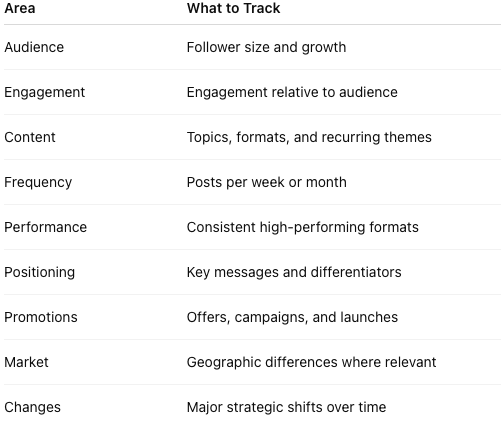
You can always add more information later.
Starting with fewer metrics makes it easier to identify relationships between them.
For example, if engagement rises after a competitor increases educational content, that’s worth investigating. If follower growth rises but engagement falls, that tells a different story.
The value comes from connecting the dots.
The Data You Ignore Can Be Just as Important
Good competitor analysis isn’t about knowing everything.
It’s about knowing what matters.
Track the metrics that help explain audience behavior, content performance, positioning, and strategic changes. Pay attention to patterns instead of isolated successes. Record when and where data was collected, particularly when working across different markets.
And be skeptical of numbers that look impressive without explaining anything.
The best competitor analysis doesn’t produce the biggest spreadsheet.
It produces better questions.
Why is this format working?
Why did engagement change?
Why is this competitor investing in a particular market?
Why does the same product appear differently across locations?
Why are some posts consistently outperforming others?
Those questions are where the useful insights usually begin.
Because in social media competitor analysis, more data isn’t necessarily better.
Better-contextualized data is.